
Schedule Your Wichita, KS SxS & UTV Diagnostics Service
(316) 260-8039 Call Big Dog Powersports.
If your side-by-side isn’t running like it should, proper diagnosis is often the difference between a quick repair and replacing parts that never needed to be changed. Big Dog Powersports provides professional SxS diagnostics, maintenance, and repair services for riders throughout Wichita and the surrounding area.
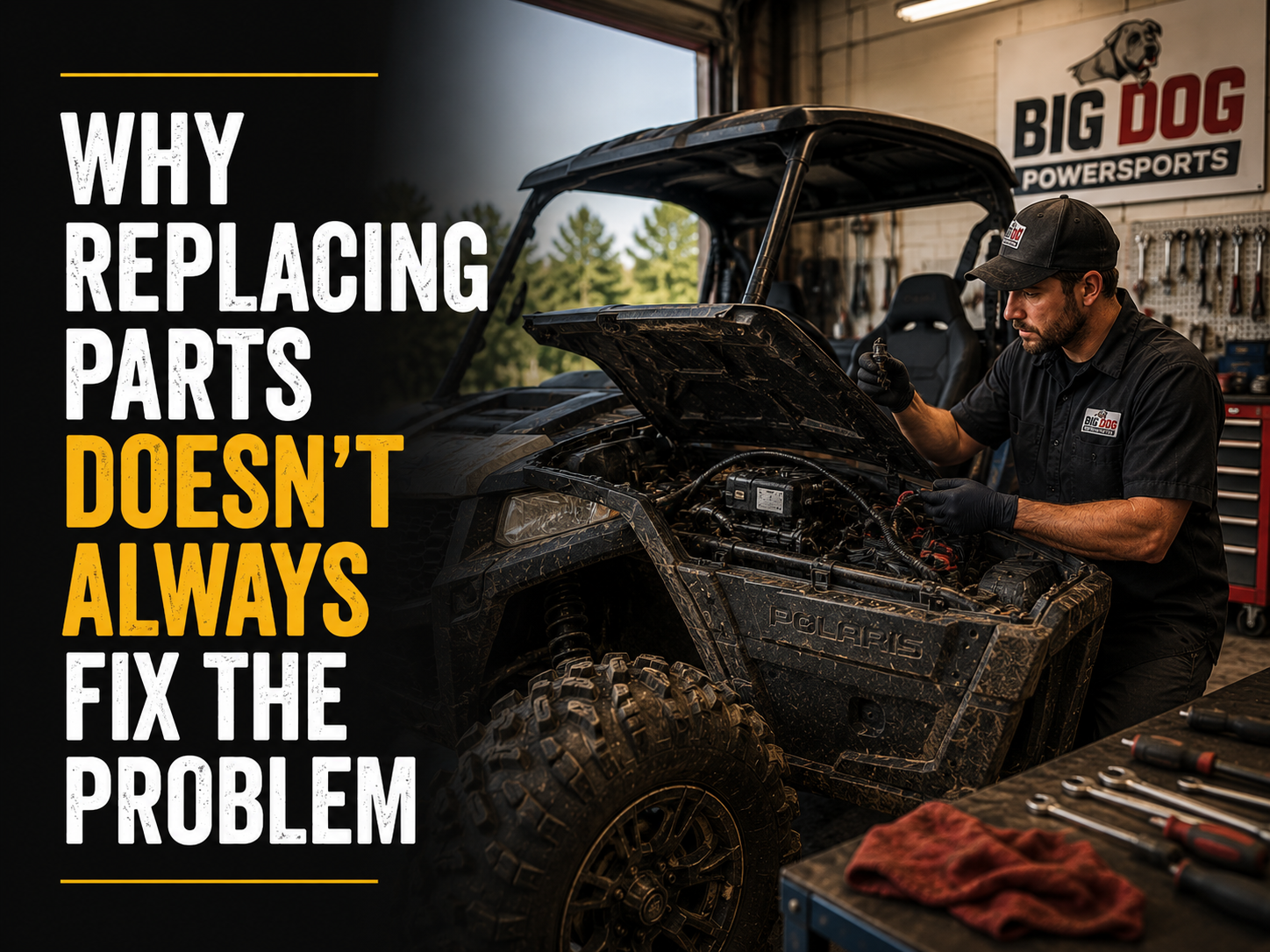
Why Replacing Parts Doesn’t Always Fix the Problem
If you’ve owned a UTV for any length of time, you’ve probably experienced the temptation.
The machine develops a problem.
You search online, talk with friends, or watch a few videos. Before long, someone confidently says, “It’s probably this part.”
Sometimes they’re right.
Sometimes replacing that part solves the problem completely.
But after spending time around the shop and talking with experienced technicians, I’ve learned that mechanical troubleshooting isn’t always that straightforward.
One thing I’ve noticed is that people often confuse a symptom with the actual cause of the problem.
Those two things aren’t always the same.
Understanding the difference can save time, frustration, and sometimes a considerable amount of money.
A Symptom Is a Clue, Not Always the Answer
Imagine you wake up with a fever.
The fever tells you something isn’t right.
What it doesn’t tell you is exactly why.
The cause could be several different things.
That’s why doctors don’t treat the fever alone—they work to understand what’s causing it.
Mechanical problems work much the same way.
A UTV that won’t start…
A new vibration…
A warning light…
A loss of power…
Those are symptoms.
They point toward a problem.
They don’t automatically identify the problem.
One of the biggest lessons I’ve learned from being around experienced technicians is that symptoms provide direction, not certainty.
The Obvious Part Isn’t Always the Problem
When something stops working, it’s natural to focus on the component closest to the symptom.
If the battery won’t stay charged, many people assume the battery itself has failed.
If the engine doesn’t run smoothly, it’s easy to wonder if one particular component is to blame.
Sometimes those assumptions turn out to be correct.
Many owners are surprised to learn that other times, the part everyone suspects is simply reacting to a problem somewhere else.
That’s one reason experienced technicians tend to avoid making quick conclusions based on symptoms alone.
Their goal isn’t to identify the first possible answer.
Their goal is to identify the correct one.
One Symptom Can Have More Than One Cause
One thing I’ve noticed while talking with customers is that people often expect every symptom to have one obvious explanation.
In reality, several different issues can sometimes produce very similar results.
For example, a machine that suddenly becomes difficult to start may have more than one possible cause.
The same is true for poor performance, unusual noises, warning lights, or other changes in behavior.
From the driver’s seat, those problems may feel nearly identical.
That’s one reason troubleshooting can be more challenging than it first appears.
The symptom tells you where to begin looking.
It doesn’t always tell you where you’ll finish.
Guessing Can Become Expensive
One pattern we’ve seen over the years is that people genuinely want to solve the problem as quickly as possible.
That’s understandable.
If your UTV isn’t running the way it should, you want to get back to riding, working, or enjoying your property.
The temptation is to replace the part that seems most likely to be responsible.
If the problem remains, another part gets replaced.
Then another.
Before long, several perfectly good components may have been replaced while the original problem still exists.
Nobody sets out to do that.
It happens because troubleshooting based on assumptions can lead people in the wrong direction.
One correct diagnosis is often less expensive than several incorrect repairs.
Good Troubleshooting Is Really a Process of Elimination
Before spending time around the shop, I assumed troubleshooting was mostly about knowing the answer.
I’ve learned it’s often about asking the right questions.
When did the problem begin?
Did it appear suddenly or gradually?
Does it happen every time?
Does it only happen under certain conditions?
Has anything changed recently?
Experienced technicians gather information before reaching conclusions.
They test ideas.
They eliminate possibilities.
They verify what they’re seeing rather than assuming they already know the answer.
To someone watching from the outside, that process can seem slower than simply replacing a part.
In reality, it’s often what prevents unnecessary repairs.
Your Observations Matter More Than You Think
One thing I’ve noticed is that owners sometimes hesitate to mention details because they assume they’re unimportant.
In reality, those observations can be extremely valuable.
You know your machine better than anyone else.
You know when it started acting differently.
You know whether the problem happens all the time or only once in a while.
You know if there was a strange smell, an unusual vibration, or a warning light before anything else changed.
You don’t have to explain why those things happened.
Simply describing what you experienced can help create a clearer picture of what’s going on.
Sometimes the smallest detail ends up being one of the most useful.
The Goal Is to Solve the Problem
One idea keeps coming back to me after spending time around experienced technicians.
Their objective isn’t to replace parts.
It’s to solve problems.
Those aren’t always the same thing.
Sometimes replacing a part is exactly what’s needed.
Other times, replacing that same part would leave the original issue untouched.
That’s why experienced troubleshooting focuses on understanding the cause before deciding on the solution.
When the cause is identified correctly, the repair becomes much more straightforward.
Final Thoughts
One of the things I appreciate most about working around experienced technicians is seeing how patient they are with the troubleshooting process.
They don’t seem interested in finding the quickest answer.
They’re interested in finding the right answer.
That’s a philosophy I’ve come to appreciate.
As owners, it’s easy to focus on the symptom because that’s what we can see, hear, or feel.
But symptoms are only the beginning of the story.
Whether it’s a new vibration, a hard starting condition, a warning light, or a loss of power, the most obvious part isn’t always the part causing the problem.
Replacing parts sometimes fixes the issue.
Understanding the cause is what solves it.
And in the long run, solving the actual problem is almost always the better investment.
Watch: Professional SxS Service & Repair
For more information about professional side-by-side maintenance and repairs, watch this video:
Big Dog Powersports SxS Service Video.
If you’re visiting or riding around the area, check out everything happening in
Wichita, Kansas.
Find us at Big Dog Powersports Wichita, KS.