
Schedule Wichita UTV Diagnostics & Repair Service
(316) 260-8039 Call Big Dog Powersports
One of the most common questions we hear at the shop is:
“What do you think is wrong with it?”
It’s a fair question. If your UTV won’t start, is making a strange noise, losing power, showing a warning light, or simply isn’t operating the way it should, you want answers as quickly as possible.
What surprises many owners is that the answer often isn’t obvious, even to experienced technicians.
I’m not one of the technicians in the back turning wrenches every day. My role is helping customers understand the process, coordinating communication, and making sure expectations are clear. Over time, I’ve noticed that many people aren’t quite sure what a diagnostic actually involves.
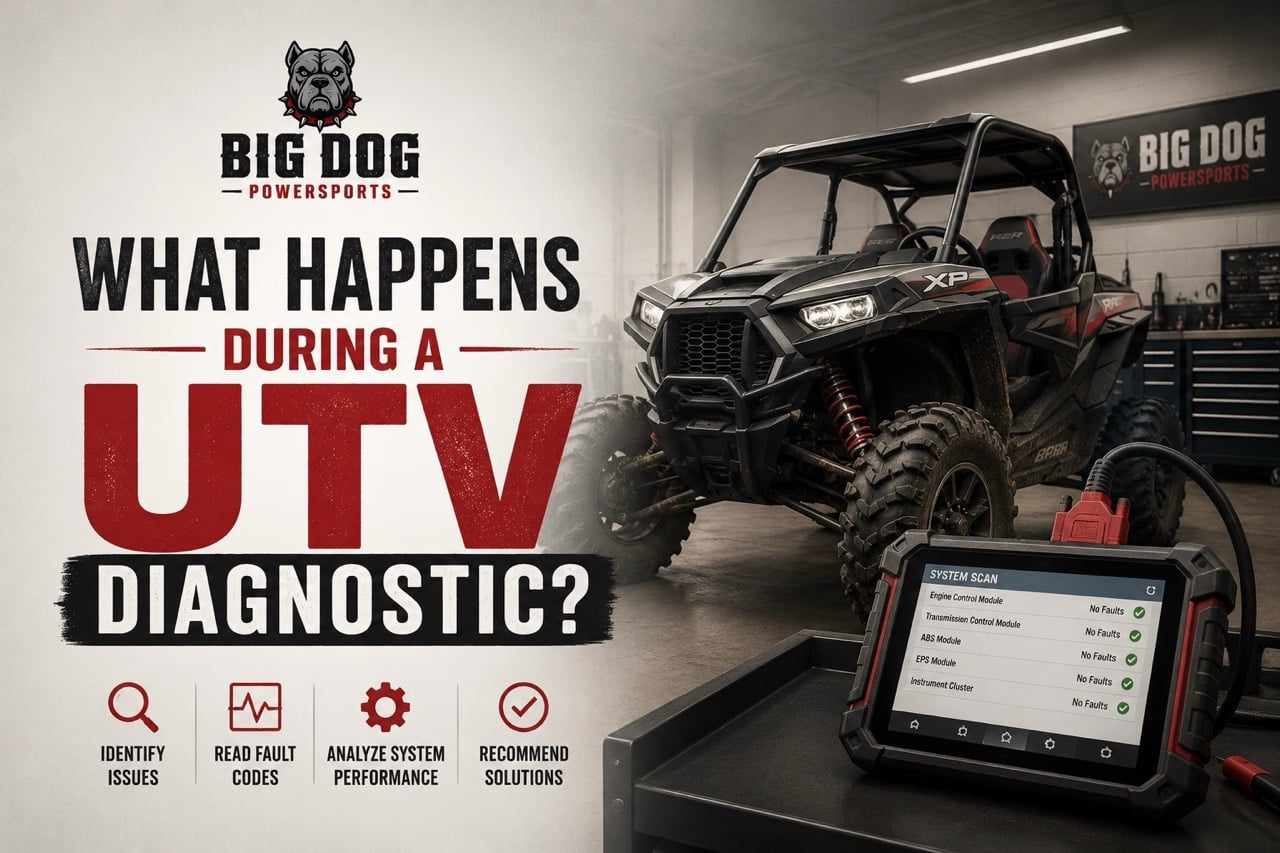
So let’s pull back the curtain and explain what happens during a UTV diagnostic and why it matters.
If you’ve never gone through a professional UTV diagnostic before, understanding the process can help set expectations and explain why testing is such an important part of the repair process.
What Is a Diagnostic?
A diagnostic is the process of identifying the actual cause of a problem.
That may sound simple, but it’s very different from guessing.
When a machine arrives at the shop, the symptom is often obvious:
- It won’t start
- It runs rough
- It stalls
- It won’t shift properly
- It has a warning light
- It makes an unusual noise
- It lost power
The symptom tells us something is wrong.
The diagnostic process is what determines why it’s happening.
Think of it like visiting a doctor. A cough is a symptom. The cause could be several different things. Before prescribing treatment, the doctor needs to determine what’s actually causing the problem.
The same principle applies to powersports equipment.
Why Can’t You Tell Me What’s Wrong Over the Phone?
This is probably the most common misconception we encounter.
Customers often call and describe a symptom, hoping we can immediately identify the problem.
Sometimes we can provide possibilities based on experience. Certain symptoms tend to point toward certain issues.
But the reality is that multiple failures can create very similar symptoms.
For example, a machine that won’t start could be experiencing:
- A battery issue
- A charging system issue
- A fuel delivery issue
- A sensor issue
- A wiring problem
- A switch or connection problem
- Something else entirely
From the customer’s seat, all of those problems can look exactly the same.
The machine won’t start.
Without seeing the vehicle, testing components, and verifying information, any answer given over the phone is simply an educated guess.
Good shops try to avoid guessing.
For many issues, a professional inspection and UTV diagnostic service is the fastest way to determine the actual cause of the problem.
What Are Technicians Actually Doing During a Diagnostic?
Many people imagine a technician plugging in a computer, reading a code, and instantly knowing what’s wrong.
While electronic testing can sometimes be part of the process, diagnostics are usually much more involved than that.
The exact process varies depending on the issue, but technicians may:
- Verify the customer’s concern
- Inspect the machine visually
- Test systems and components
- Check electrical connections
- Evaluate warning codes or stored information
- Measure operating conditions
- Confirm whether parts are functioning properly
- Rule out possible causes one by one
In many cases, the technician is working through a process of elimination.
They’re gathering evidence.
They’re testing theories.
They’re narrowing down possibilities until they can confidently identify the root cause.
That’s why diagnostics require both time and experience.
Why Does a Diagnostic Cost Money?
Another question we hear frequently is:
“Why am I paying for a diagnostic if nothing has been repaired yet?”
The simplest answer is that diagnostics are skilled labor.
The value isn’t in replacing a part.
The value is determining which part actually needs attention in the first place.
An experienced technician may spend considerable time inspecting, testing, verifying, and ruling things out before arriving at a conclusion.
That expertise has value because it helps prevent unnecessary repairs.
A proper diagnosis often saves far more money than it costs.
Why Can’t You Quote the Repair Before Diagnosing It?
Customers understandably want to know what a repair will cost.
The challenge is that repair costs depend on knowing what’s actually wrong.
Imagine calling a doctor and saying:
“My stomach hurts. How much will treatment cost?”
There isn’t enough information yet.
The same challenge exists with mechanical issues.
Until the diagnostic process identifies the root cause, there may be several possible repairs with very different costs.
Providing a firm quote before diagnosing the machine would be little more than speculation.
Our preference is to provide accurate information rather than optimistic guesses.
Why Diagnostics Usually Save Money
One of the most expensive ways to repair a machine is replacing parts based on assumptions.
Most powersports owners know someone who has experienced this:
A problem appears.
One part gets replaced.
The problem remains.
Another part gets replaced.
The problem remains.
Eventually the actual issue is found after several unnecessary expenses.
Diagnostics help prevent that cycle.
By identifying the cause before replacing components, the repair process becomes more targeted, more efficient, and often less expensive overall.
The goal isn’t to replace more parts.
The goal is to replace the right parts.
Modern Machines Are More Complex Than Many People Realize
Many UTV owners are comfortable performing basic maintenance and repairs themselves.
That’s a good thing.
But today’s machines combine mechanical systems, electrical systems, sensors, controls, and safety systems that often interact with one another.
A single issue can create symptoms in multiple areas.
Likewise, multiple symptoms may ultimately trace back to one root cause.
This is another reason diagnostics are important.
What appears to be a major failure isn’t always major.
What appears to be a minor issue isn’t always minor.
The testing process helps separate assumptions from facts.
Here in Kansas, we regularly see machines affected by dust, mud, farm use, trail riding, extreme summer heat, and cold-weather operation. Those conditions can create symptoms that look similar on the surface but have very different underlying causes. That’s one reason diagnostics are so important before replacing parts or making repair decisions.
The Goal Is Confidence
At the end of the day, the purpose of a diagnostic isn’t to sell repairs.
The purpose is to create clarity.
When a machine arrives at the shop, there’s uncertainty.
The owner doesn’t know what’s wrong.
The technician doesn’t know what’s wrong.
The diagnostic process bridges that gap.
Once the problem has been properly identified, everyone can have a more productive conversation about timelines, repair options, costs, and next steps.
Whether you use your UTV for work around Wichita-area properties, hunting, trail riding, or recreation across Kansas, accurate diagnostics help ensure repair decisions are based on facts rather than assumptions.
Whether the issue turns out to be simple or complex, having accurate information is almost always better than guessing.
And that’s ultimately what a diagnostic is designed to provide: confidence that decisions are being made based on facts rather than assumptions.
Article by Mike Gamache
Mike works with customers and operations at Big Dog Powersports in Wichita, Kansas. While he isn’t one of the technicians performing diagnostics and repairs, he spends his days helping customers understand the service process, coordinating communication, and working closely with the shop team. His goal is to make powersports ownership a little less confusing and a lot less frustrating.
UTV Service & Diagnostics.
Learn more about the Wichita area at Visit Wichita.
Find us at Big Dog Powersports Wichita, KS.