
Schedule Wichita, KS UTV maintenance with Big Dog Powersports
(316) 260-8039 Call Big Dog Powersports.
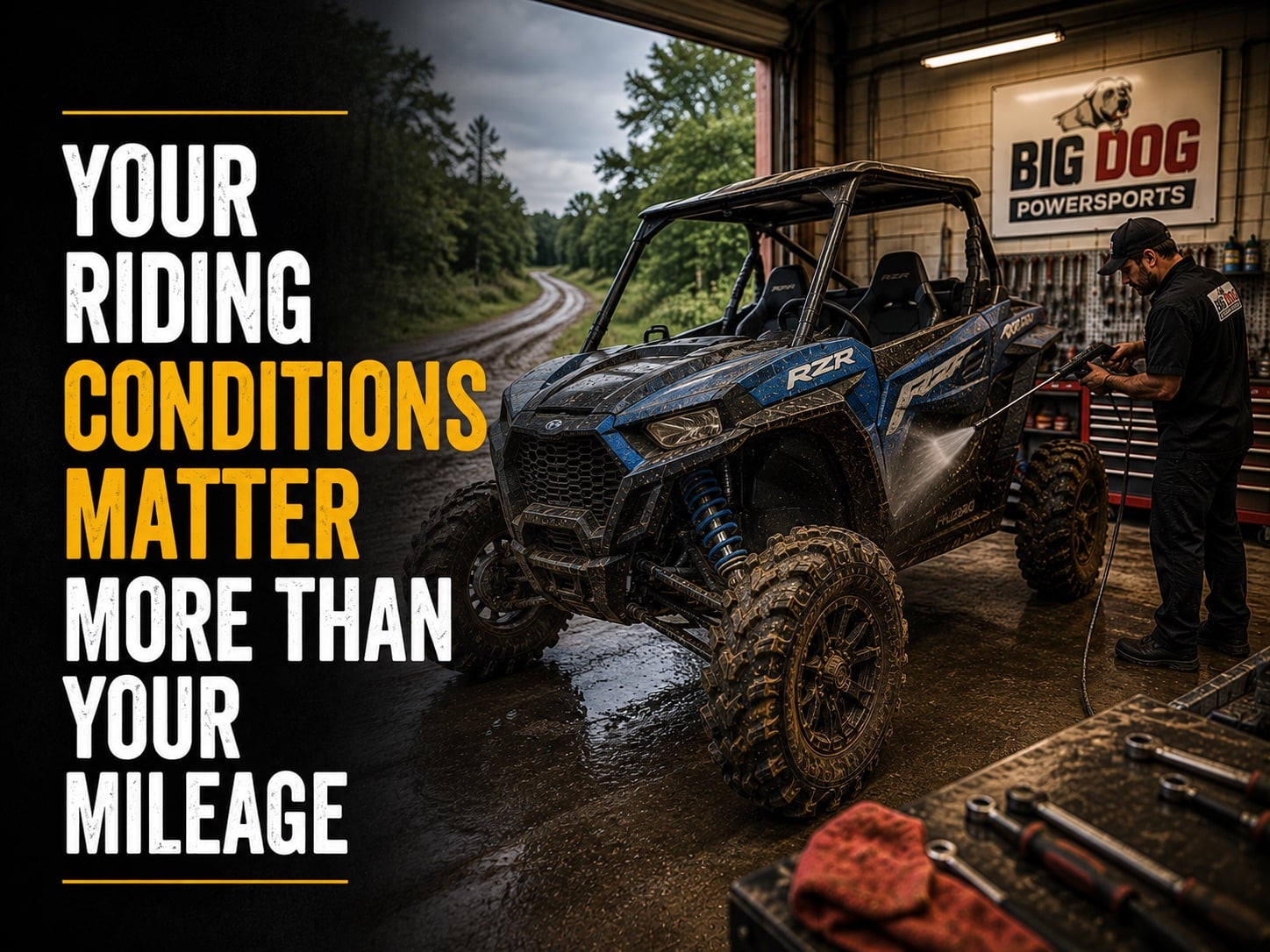
Your UTV or ATV riding conditions can tell you something the odometer and hour meter cannot. Mileage and operating hours are useful because they tell us how much a machine has been used. But they do not tell us what those miles and hours actually looked like. A machine that spends most of its time on relatively clean, moderate trails may experience a very different kind of use than another machine with similar mileage that works in heavy dust, mud, heat, water, or under load.
One thing I’ve learned from being around the shop and talking with owners is that it is easy to look at the number on the dash and let that number tell the whole story. It rarely does.
The better way to think about it is simple: mileage and hours tell us how much a machine has been used. Riding conditions help tell us what those miles and hours were like.
Why Riding Conditions Add Context to Mileage and Hours
Imagine two side-by-sides that both show 100 operating hours.
One has spent those hours on relatively clean trails at moderate speeds. The other has spent many of those same 100 hours following another machine down dusty Kansas back roads, crawling around a property at low speed, or working through muddy fields.
The number on the hour meter is the same. The environment those machines experienced is not.
That does not automatically mean the second machine is in worse condition, and it certainly does not mean it was mistreated. UTVs and ATVs are built to be used. Work, trail riding, hunting, mud, sand, and property chores are all normal reasons people own them.
The point is that the way a machine is used gives useful context when deciding what deserves attention.
Manufacturer maintenance schedules still matter and should remain an important reference point. But operating conditions and regular inspection add information that mileage or hours alone cannot provide.
Not All Miles and Operating Hours Are Equal
It is easy to think of mileage as a simple measurement of wear. More miles must mean more use, and fewer miles must mean less use.
That is true in a broad sense, but it is incomplete.
A mile traveled on a smooth road at a steady pace is not necessarily the same operating experience as a mile spent climbing loose terrain, creeping through mud, hauling a load, or moving slowly through a dusty pasture.
The same applies to hours. An hour meter records time while the machine is operating. It does not explain whether that hour was spent cruising at a moderate pace, idling and stopping repeatedly during farm work, or working through demanding terrain on a hot day.
This is why two machines with nearly identical numbers on the dash can have different inspection and maintenance needs.
Dust Is a Good Example of Why Conditions Matter
Here in Kansas, dust is one of the easiest examples to understand.
A machine may spend hours on dry gravel roads, across dusty fields, or following other riders where airborne dirt hangs behind the group. Another UTV might accumulate the same number of hours in cleaner conditions.
Those machines have experienced different environments.
Dust can collect on filters, cooling surfaces, suspension components, and other exposed areas. How much that matters depends on the machine, its design, how it is equipped, and how severe the conditions are.
There is no useful formula that says one dusty hour equals some fixed number of clean hours. That kind of comparison sounds precise, but real-world use is much more complicated than that.
What matters is recognizing the environment your machine has been working in.
If you know your UTV spends a lot of time in heavy dust, that is useful information when you inspect it, review its maintenance history, or talk with a technician. The hour meter cannot tell you that part of the story.
Mud and Water Tell Their Own Part of the Story
A muddy UTV is not evidence of poor ownership. Plenty of people buy a side-by-side specifically because they want something capable of getting through sloppy trails, wet fields, creek crossings, or rough property.
But mud and water expose a machine to conditions that clean, dry trail riding does not.
Mud can collect around components and hold moisture or debris in places an owner may not immediately notice. Water exposure can also matter depending on its depth, duration, and where it reaches on a particular machine.
That does not mean every muddy ride creates a mechanical problem. It simply means the conditions are worth considering when evaluating the machine afterward.
A 500-mile UTV that has spent much of those miles in wet, muddy environments has lived a different life than a 500-mile machine that has mostly traveled dry roads and moderate trails.
The odometer shows the same number. The machines may not have experienced the same stresses.
Slow-Speed Work Can Be Very Different From Recreational Riding
A pattern we see with working machines is that mileage sometimes understates how much work they are actually doing.
Think about a UTV on a farm, ranch, acreage, or jobsite. It may spend a lot of time moving slowly, starting and stopping, carrying supplies, pulling a trailer, checking fence, feeding animals, or traveling short distances around a property.
It might not accumulate miles very quickly.
But low mileage does not mean the machine has been sitting idle.
Slow-speed operation, heavier loads, towing, frequent stops, and extended running time can create a very different operating pattern than a recreational machine that travels longer distances at more consistent speeds.
Neither use is inherently better or worse. A working UTV is doing exactly what its owner bought it to do.
The useful question is not simply, “How many miles are on it?” It is also, “What has the machine been doing during those miles?”
That is especially important for machines used for both work and recreation. A side-by-side might spend Friday hauling around the property and Saturday covering miles on a trail. Looking at the complete use pattern gives a better picture of the machine’s life.
Heat, Sand, and Demanding Terrain Change the Environment
Temperature and terrain add another layer.
Extreme summer heat can make operating conditions more demanding, particularly when a machine is moving slowly or working under load. Sand and dunes bring loose terrain, airborne material, and sustained engine and drivetrain demand. Rough hardpack can expose suspension and chassis components to a different kind of use than smooth roads.
None of those conditions automatically mean something is wrong or that a repair is coming.
They simply help explain why two owners with similar mileage may have different observations when they inspect their machines.
This is one reason the owner’s knowledge of the machine is so valuable. You know whether the last several rides were easy cruises, dusty group rides, hot summer workdays, muddy weekends, or long days hauling gear.
That history adds meaning to the number on the dash.
A Low-Mileage Machine Is Not Automatically a Low-Maintenance Machine
There is another side to this that is easy to miss: sometimes a machine has very few miles because it spends a lot of time sitting.
It is tempting to assume a low-mileage UTV or ATV should automatically need very little attention. But storage creates its own operating context.
Batteries can lose charge. Fuel can age. Tires can lose pressure. Moisture and corrosion may become concerns depending on where and how the machine is stored. Rubber components and seals continue to age even when the odometer is not moving.
This is why a machine with extremely low annual mileage is not necessarily the same as a machine that is used regularly but gently.
One has been operating. The other may have spent months parked.
The odometer records distance. It does not record inactivity.
Recreational and Work Machines Can Accumulate Different Kinds of Stress
Two owners can use the same general type of machine for completely different purposes.
A weekend trail rider might put on miles quickly during a handful of long recreational trips. A ranch owner might put on fewer miles while using the machine almost every day for short trips, hauling, towing, and slow-speed work.
A hunter may use an ATV heavily for a few weeks each year and then store it for long stretches. A dune rider may cover plenty of ground in sand and heat. A property owner may spend hours creeping through rough terrain without traveling very far.
None of these use patterns automatically tells us that one machine will need a particular repair before another.
What they do tell us is that mileage alone cannot fully describe machine use.
That is why conversations about maintenance are more useful when they include questions about how the machine is actually operated.
Manufacturer Maintenance Schedules Still Matter
Riding conditions should add context to manufacturer recommendations, not replace them.
Owners should still pay attention to the maintenance guidance provided for their specific UTV or ATV. Those recommendations give you a baseline for routine service and inspection.
Operating conditions help you understand what else may deserve attention between or alongside those scheduled points.
If a machine has recently spent days in heavy dust, deep mud, water, severe heat, or demanding work, it makes sense to keep those conditions in mind when looking the machine over.
That does not mean inventing your own maintenance schedule or assuming something must be failing. It simply means using what you know about the machine’s life as additional information.
For owners who want help evaluating that bigger picture, Big Dog Powersports offers UTV and side-by-side service in Wichita, including routine maintenance, diagnostics, inspection, and repair.
Pay Attention to the Life Your Machine Actually Lives
You do not need to turn UTV or ATV ownership into a complicated record-keeping exercise.
Just pay attention to how the machine is used.
Think about where it spends its time. Think about whether most of its hours come from trail riding, ranch work, hunting, towing, sand, dust, mud, heat, short trips, or long periods of storage.
Those details help provide context for the mileage and hours you already track.
And that is really the central point.
Use your machine for what you bought it for. Work it. Hunt with it. Take it down the trail. Get it muddy if that is where you ride. Just remember that the way you use it should help inform the way you care for it.
The Numbers Matter, but the Machine’s Actual Life Provides Context
An odometer gives you miles. An hour meter gives you operating time. Both are useful.
What they cannot tell you is whether those miles and hours came from clean recreational riding, dusty Kansas trails, slow ranch work, summer heat, deep mud, towing, sand, water, or months separated by long periods of storage.
That context comes from knowing the machine.
Good maintenance decisions come from looking at both sides of the picture: the numbers tell you how much the machine has been used, and its actual life tells you what that use looked like.
Watch Big Dog Powersports UTV and side-by-side service information for Wichita, Kansas riders.
For more information about the area we ride and work in, visit Wichita, Kansas.
Find us at Big Dog Powersports Wichita, KS.